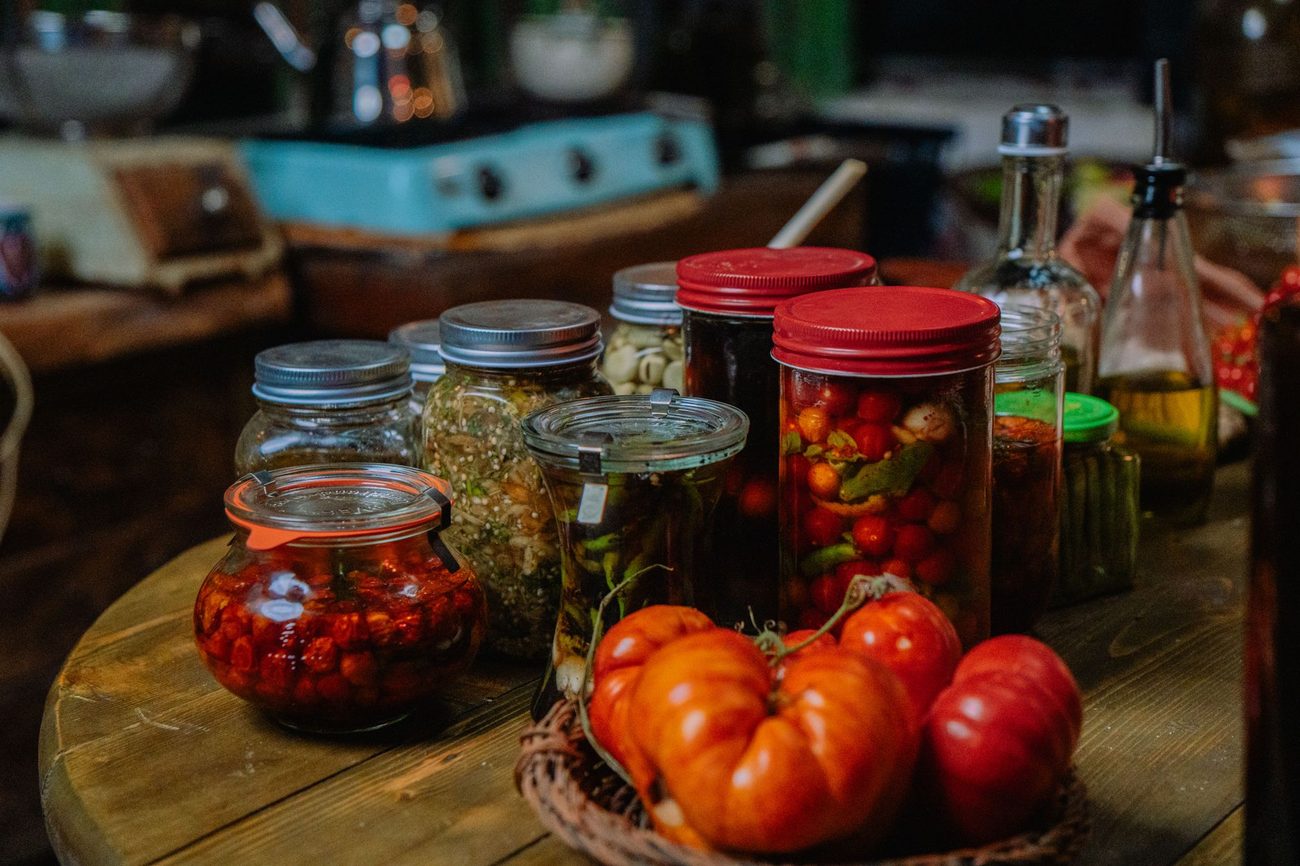
Saturday at 1 o'clock, the kitchen smells like tomatoes and the big canner is already rattling on the front burner. This is the fourth Saturday in a row I've done this, and Greg has learned to make himself scarce. He has gone to look at something in the garage, which in his language means the garage is cooler.
This spring I filled one whole raised bed and half of the other with eight Roma tomato plants. The rest went to peppers and one zucchini. Just one, as I promised myself last year.
Eight plants is too many tomatoes for two people to eat fresh. It's about the right number for small-batch canning.
Small batches, and why
My mother canned bushels every August, all day long, with everyone in the family snapping, peeling and boiling. I don't have the crew, the stamina or the counter space for that. So I pick through the week, let the tomatoes ripen on the counter, and can once on Saturday afternoon with whatever I have, usually about 15 pounds.
Fifteen pounds of Romas cooked down makes about six pints of sauce. It takes me roughly three hours from washing to the jars coming out of the canner. That's a Saturday afternoon, not a whole weekend, and my knees approve.
I use Mom's old enameled water-bath canner, which she gave me when she moved into the condo, and a rack that holds seven pints.
Doing it safely
I'm not inventing anything here. I follow a tested recipe for plain tomato sauce from the National Center for Home Food Preservation, the same one Ohio State's extension office points to, and I don't freelance. A few things matter more than people think:
- Add acid to every jar. Tomatoes are borderline on acidity, so tested recipes call for 1 tablespoon of bottled lemon juice per pint, or 1/4 teaspoon of citric acid. Bottled, not fresh, because the acidity is consistent.
- Plain sauce only. No onions, garlic, peppers or oil in the jars. Those lower the acidity, and a sauce with vegetables needs a different tested recipe and a pressure canner. I season when I open a jar in January.
- Follow the processing time. Pints of tomato sauce get 35 minutes in a full rolling boil, with water covering the jars by an inch. That time is for altitudes under 1,000 feet, which is us here in Franklin.
- Leave 1/4 inch of headspace, wipe the rims clean, and tighten the bands only fingertip tight.
When the timer goes off, I turn off the heat, wait five minutes, and lift the jars onto a towel to sit undisturbed overnight. In the morning I check every lid. If one didn't seal, it goes in the refrigerator and gets used that week. I take the bands off, label each jar with the date, and store them in the basement, where they're best within a year.
What each jar really cost
I kept every receipt, because I suspected the answer wasn't going to flatter me.
Eight tomato plants in May at $3.99 each came to $31.92. A bag of garden fertilizer was $12. I had a dozen pint jars from Mom and bought another dozen for $14.49. Two boxes of 12 lids, $8.58. Two bottles of lemon juice, $5.58. Gas for the stove and water for four batches, maybe $4.
That's $76.57 so far for 22 pints, or about $3.48 a jar. Next year, without buying jars, it should be closer to $2.80.
Here's the honest part. A 24-ounce jar of store-brand pasta sauce at Aldi is $1.69, which works out to about $1.13 a pint. My sauce costs two to three times as much. If I were canning to save money, I'd stop.
I'm not, though. It tastes like August. It has nothing in it but tomatoes, lemon juice and a pinch of salt. And there's something about a basement shelf with 22 jars on it that makes a quiet house feel a little more stocked and a little less empty.
Greg's verdict, after a spaghetti dinner from the first batch: "Your mom's was thicker." He's right. Next Saturday I'm cooking it down longer.